spatiotempo
About the project
DUT – Driving Urban Transitions
is a DUT (Driving Urban Transitions) research project within the 15-Minute City Transition Pathway (15mC TP). The 15mC TP addresses challenges related to urban mobility, logistics, public spaces with the aim of promoting the implementation of resilient neighbourhoods for all.
15-Minute City
The four key principles of the 15-minute city, according to Moreno et al. (2021), are: proximity, density, diversity and digitalisation. However, the 15mC emphasizes proximity, often through a spatial lens yet overlooking time as a planning dimension. Although “time” features in its name, proximity is often understood as physical distance rather than temporal accessibility.
SPATIOTEMPO
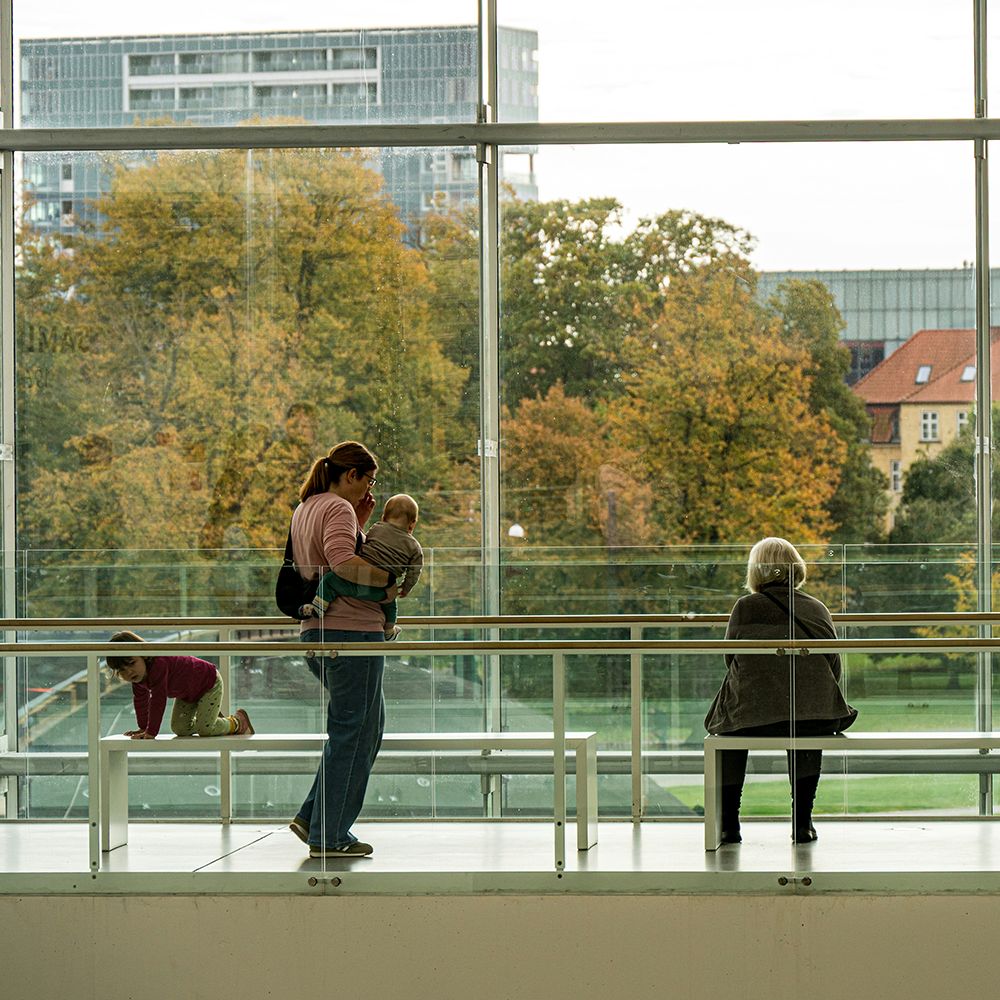
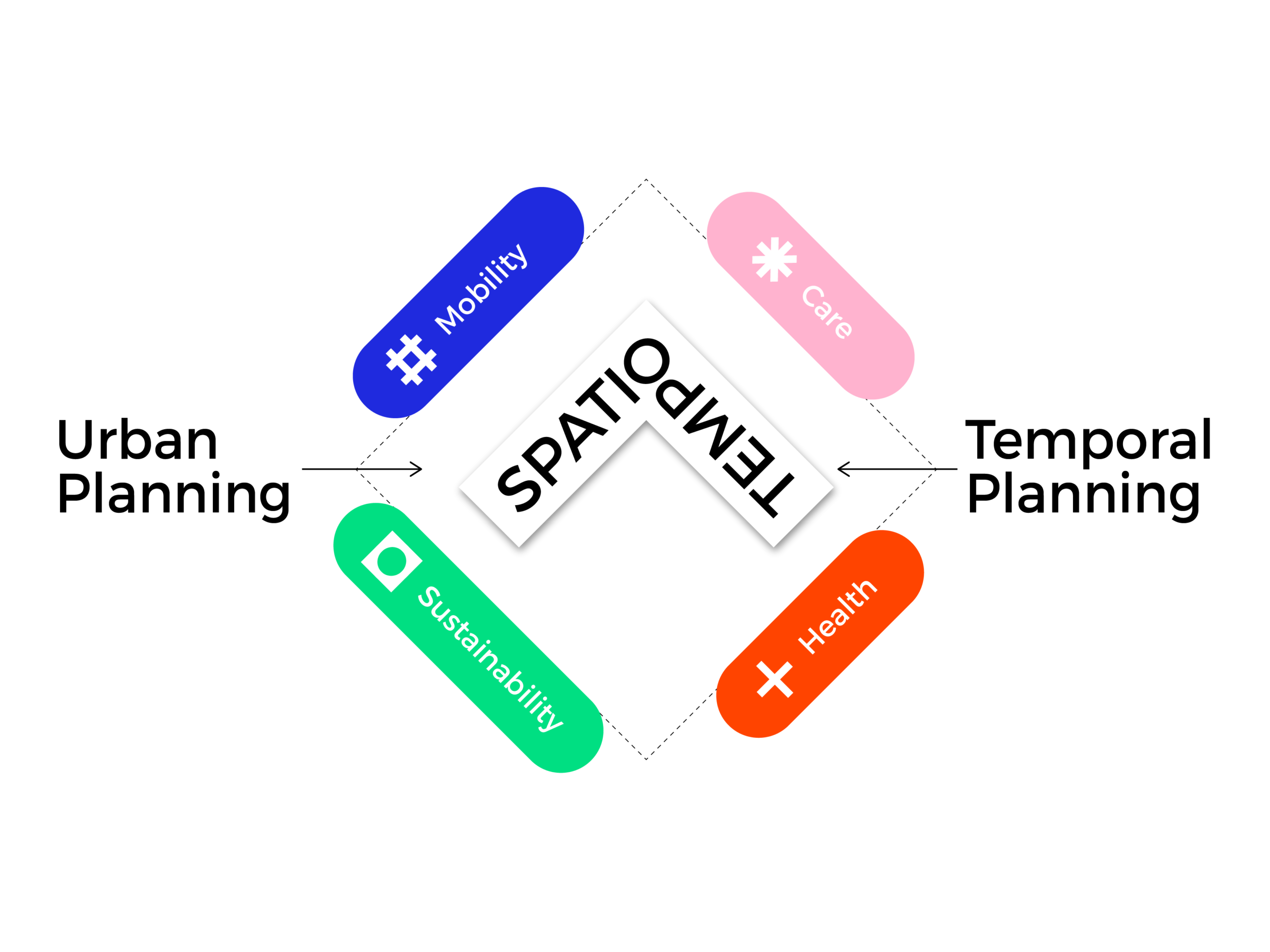
The project recognises that, alongside physical infrastructure, time is a force that shapes, enables, constrains and preconfigures contemporary urban life. SPATIOTEMPO expands current understanding of the 15-minute city by drawing attention to cities as spatio-temporal systems.
SPATIOTEMPO explores how urban life is shaped not only by spatial factors, but also by temporal ones.

Approach
Time-oriented planning shapes social provisioning, meaning the organization of services, infrastructures, and care arrangements in the city. Social provisioning then produces local welfare outcomes, influencing people’s access to services and their everyday experiences. These outcomes are finally evaluated against the vision of a Caring City, which serves as the normative horizon for assessing whether urban development supports care, inclusion, equity, and well-being.
Developed using mixed methods:
1.
Time-use surveys with geolocational data
2.
Interviews with policymakers and time (planning) experts
3.
Co-creation workshops
4.
Strong public engagement and dissemination efforts
Expected outcomes

Analytically
We generate data to provide evidence on space–time interactions, identify time-poor groups, and develop new tools to visualise everyday rhythms and service use.

Institutionally
We create (1) a toolbox for spatio-temporal planning and (2) a roadmap for the implementation of time offices, supporting adaptation in other contexts.

Socio-politically
We promote democratic and inclusive proximity urbanism for more time sovereignty & synchronisation, and strengthen residents‘ participation through co-creation and public engagement.
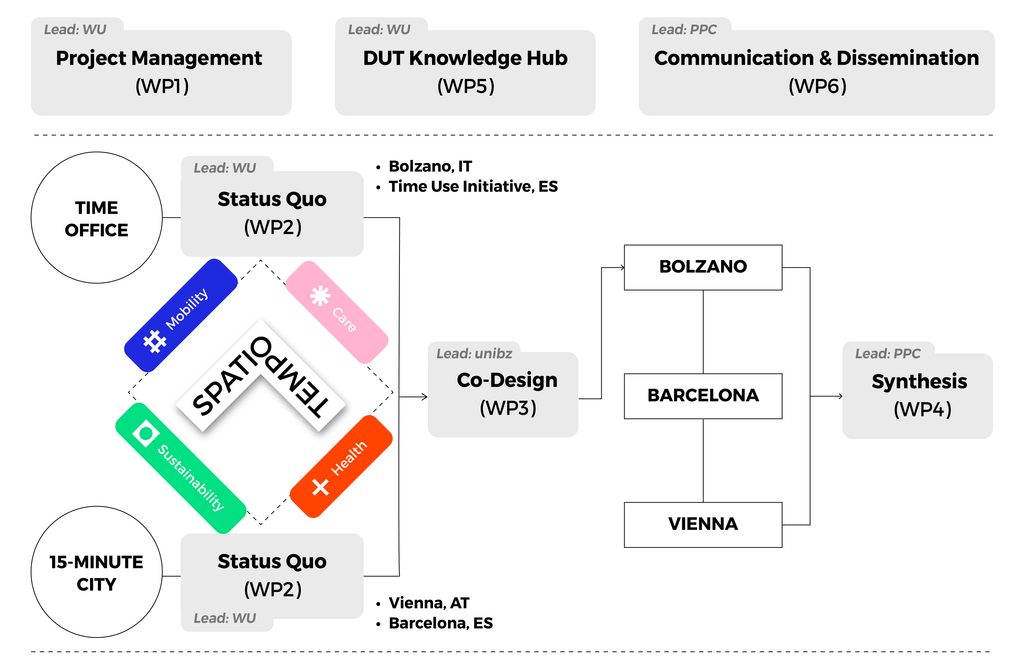
The project is structured around six interconnected work packages. WP1 provides coordination and groundwork; WP2 investigates the status quo through empirical research; and WP3 develops participatory scenarios. WP4 translates these insights into transferable frameworks and tools, while WP5 connects the project to the DUT Knowledge Hub and WP6 supports knowledge transfer and dissemination.